Masoretic text
The translation stands on the received Hebrew of the Masoretic tradition — the consonants, vowels, and accents by which Genesis has been read and kept.
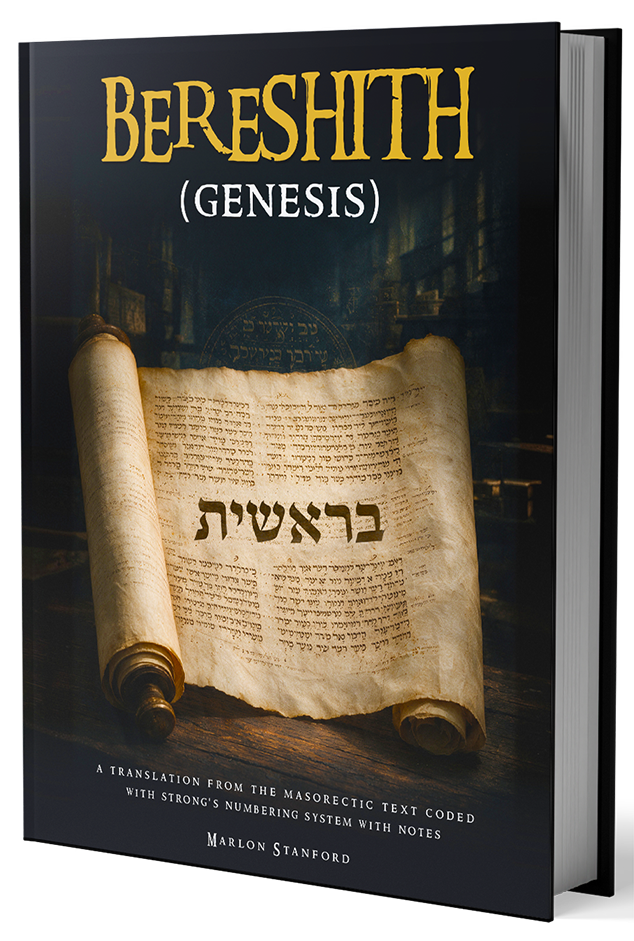
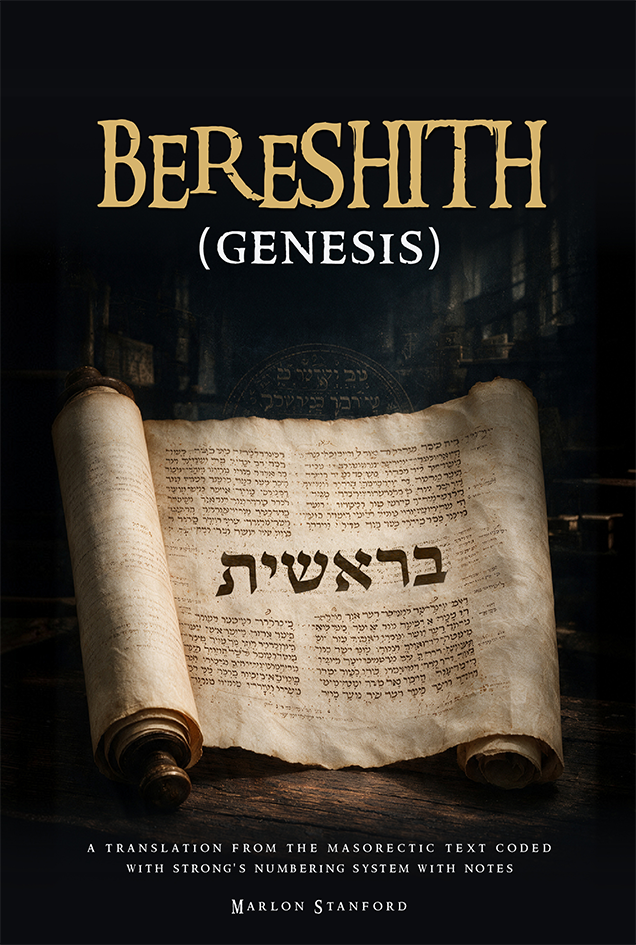
Bereshith
The book of beginnings
(Genesis)
A translation from the Masoretic text, coded with Strong’s numbering system, and set with notes — so every Hebrew word can be seen, numbered, and studied.
01
About the book
Bereshith is Genesis read from the Hebrew itself. Marlon Stanford renders the Masoretic text into English and binds each word to its Strong’s number, then sets notes beside the line so the reader can follow the original without leaving the page.
The title is the book’s first word — בראשית, “in the beginning” — with Genesis kept beside it. Synagogue name and English name stand together, as the Hebrew and the translation do throughout.
A translation from the Masoretic text coded with Strong’s numbering system, with notes.
This is not a paraphrase that hides its source. It is a coded working text: the received consonants remain accountable, the numbers open the concordance, and the notes keep the difficult places in view.
02
How the page is built
The translation stands on the received Hebrew of the Masoretic tradition — the consonants, vowels, and accents by which Genesis has been read and kept.
Every Hebrew word is coded to Strong’s numbering system. A reader can move from the English line to the lemma, and from the lemma into the concordance, without guesswork.
Notes sit with the verse. They mark the hard places, the force of a stem, a particle that English cannot carry — so the translation stays honest to what the Hebrew is doing.
03
A taste of the coding
A public-domain illustration of the method, using Genesis 1:1. Stanford’s own translation and notes live in the book. Here, each Hebrew word opens its Strong’s number and gloss.
Genesis 1:1 · בראשית א׳:א׳
In the beginning God created the heaven and the earth.
Select a Hebrew word above.
04
The jacket
בְּרֵאשִׁית
In the beginning.
06
Correspondence